
Performance Levels Explained

06 Nov 2026
How they Contribute to Risk Reduction Under ISO 13849-1:2023
Performance Levels (PL) form a fundamental part of risk reduction under ISO 13849-1:2023. They provide a structured method for determining whether the safety-related parts of control systems (SRP/CS) can achieve the level of risk reduction required for machinery applications.
Although Performance Levels are widely used within machinery safety, there is still considerable misunderstanding around what a PL actually represents.
A Performance Level represents the ability of the safety-related parts of a control system to perform a specified safety function under foreseeable conditions, taking into account factors such as system architecture, component reliability, diagnostics and fault tolerance.
Understanding Performance Levels correctly is essential when designing machinery that is both safe and compliant.
What Is a Performance Level?
ISO 13849 defines five Performance Levels:
- PL a
- PL b
- PL c
- PL d
- PL e
As the Performance Level increases, the required probability of a dangerous failure decreases, meaning that the safety function is less likely to fail in a way that could lead to harm. Each Performance Level corresponds to a defined range of average frequency of a dangerous failure per hour (PFH). In practical terms, higher Performance Levels therefore provide greater levels of risk reduction.
However, one of the most important concepts within ISO 13849 is that a Performance Level is not an inherent property of an individual device or component. A safety relay, PLC, sensor or drive cannot achieve PL d on its own. A manufacturer's declaration states the maximum capability of that subsystem under its stated conditions of use, not the Performance Level achieved by the overall safety function. The achieved Performance Level applies to the specific safety function and the safety-related parts of the control system supporting it.
For example, a guard interlocking safety function may include:
- Input: Guard interlock switch(es) detecting whether the guard is closed
- Logic: Safety PLC or safety relay monitoring the interlock signals
- Output: Safety contactors or Safe Torque Off (STO) controlling hazardous motion
- Associated wiring and connections
- Diagnostic and fault-monitoring measures
Example safety function:
Opening the guard shall detect access to the hazardous area and remove or prevent motive power to the hazardous machine functions. Restart shall not occur solely by closing the guard.
The achieved Performance Level is determined by evaluating how reliably the complete safety function can perform under foreseeable operating and fault conditions. This distinction is important as selecting individual components capable of supporting a high-Performance Level does not automatically mean that the complete safety function achieves that same PL.
Determining the Required PLr
Before determining what Performance Level a safety function actually achieves, the designer must first establish the required Performance Level (PLr).
ISO 13849 provides a dedicated risk graph using three parameters:
- S - Severity of injury
- F - Frequency and/or duration of exposure to the hazard
- P - Possibility of avoiding the hazard or limiting harm
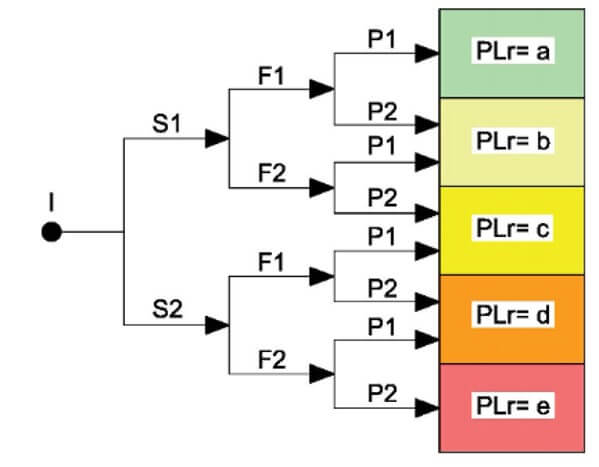
The PLr risk graph should be used after hazards and associated risks have been identified and assessed through the wider machinery risk assessment process, for example in accordance with ISO 12100.
Where the risk parameters indicate severe potential injury, frequent or prolonged exposure and limited possibility of avoidance, the resulting PLr may be relatively high, such as PL d or PL e.
The important principle is that PLr is determined by the risk associated with the specific safety function and its application.
What Determines the Achieved Performance Level?
The achieved Performance Level depends on several characteristics of the safety-related control system, including:
- System architecture / Category
- Mean Time to Dangerous Failure (MTTFd)
- Average Diagnostic Coverage (DCavg)
- Common Cause Failure (CCF) measures
- Component reliability
- Measures against systematic failures
- Software-related measures, where applicable
- Verification and validation
ISO 13849 defines five architectural Categories: B, 1, 2, 3 and 4
These Categories describe different structural characteristics of the safety-related control system and influence how the system responds when faults occur. Higher Performance Levels will generally require increasingly robust combinations of architecture, reliability, diagnostics and fault tolerance.
Verification Is Only Part of the Process
Tools such as SISTEMA can provide valuable support when evaluating the achieved Performance Level of safety-related control systems. However, producing a successful PL calculation does not, by itself, demonstrate that the safety function is fully compliant.
The engineering process must also consider whether:
- The correct safety functions have been identified
- Appropriate PLr values have been established
- The selected architecture is appropriate
- Component reliability data is suitable and correctly applied
- Diagnostic measures have been properly implemented
- Common cause failures have been addressed
- Systematic failures have been considered
- The safety function has been correctly implemented
- The completed safety function has been validated
This is particularly important because a calculation model can only assess the information and assumptions entered into it.
Validation of the Safety Function
Once the safety-related control system has been designed and the required Performance Level demonstrated, the implemented safety function must also be validated. Validation provides evidence that the safety function has been correctly specified, designed and implemented and that it performs as intended.
This may include review, analysis and functional testing of areas such as:
- Safety function behaviour
- Fault response
- Diagnostic measures
- Reset and restart behaviour
- Operating modes
- Interfaces between safety-related components
- Wiring and implementation
- Foreseeable fault conditions
Validation should therefore be considered an integral part of the ISO 13849 process rather than an activity performed simply to complete the technical documentation.
What Does ISO 13849 Readiness Look Like?
ISO 13849 readiness goes beyond calculating a Performance Level. An organisation should be able to demonstrate a structured approach covering the complete safety-function lifecycle.
This means being able to answer fundamental questions such as:
- Have machinery hazards been systematically identified and assessed?
- Have the necessary safety functions been clearly defined?
- Has a PLr been established for each relevant safety function?
- Are appropriate architectures being selected?
- Are MTTFd, DCavg and CCF being properly considered?
- Can the achieved PL be demonstrated?
- Does the achieved PL meet or exceed the required PLr?
- Have the implemented safety functions been appropriately validated?
Weakness in any one of these areas can undermine the overall functional safety argument.
Final Thoughts
Performance Levels provide a structured and globally recognised framework for machinery functional safety, helping organisations determine whether safety-related control systems can achieve the level of risk reduction required for a particular application – however, PL should never be viewed as a standalone calculation exercise or a simple box-ticking activity.
Achieving the required Performance Level depends on effective machinery risk assessment, correctly defined safety functions, appropriate system architecture, reliable components, effective diagnostics, systematic failure measures, robust verification and appropriate validation.
Good functional safety engineering is about understanding the actual machine risk and implementing safety functions capable of delivering an appropriate, reliable and defensible level of risk reduction throughout the operational life of the machinery.
How Ready Are You for ISO 13849?
Understanding Performance Levels is only one part of demonstrating an effective approach to machinery functional safety.
Take our short ISO 13849 Readiness Review to assess your current approach.
Following the review, you will receive an indication of your current ISO 13849 readiness level and recommended next steps.
Complete the ISO 13849 Readiness Review

You may be interested in...
Performance Levels Explained: How prepared is your organization for ISO 13849 compliance?
Download our ISO 13849 Readiness Review survey to evaluate your approach across 12 critical functional safety areas, identify potential gaps, and understand the next steps toward achieving and validating the required Performance Level for your safety functions.

Functional Safety Testing & Certification
From early design stages through to production, our modular FS solutions provide flexible options for manufacturers, and our FS Mark provides stakeholders with visibility for products they purchase, install, or utilize in operations.